Guide · E-invoicing in France
 E-invoicing in France, explained properly
From September 2026, French companies stop emailing invoices to each other. Exchange moves onto registered platforms, and a second obligation, e-reporting, starts feeding transaction data to the tax authority. This page explains how the system works, what it will ask of you, and where we fit.
Updated: 3 August 2026 · 6 min read
- Connected through a DGFiP-registered platform
- Factur-X, UBL and CII built in

The change
What changes in September 2026
For domestic business-to-business trade between French companies, an invoice will no longer be a document you send. It becomes a structured file that travels between two registered platforms, and the tax authority sees the essential data on the way.
Three things follow from that, and they are worth separating, because companies tend to hear only the first one.
You will need a platform. Not software, a platform: an operator registered with the tax authority. Your ERP or accounting tool keeps doing its job, but it can no longer be the last stop before your customer.
You will have to receive this way, whatever your size, from day one. The obligation to issue arrives in waves, but the obligation to receive applies to everyone at once, in September 2026. A company with four employees that only ever receives supplier invoices is still in scope.
And you will owe the tax authority data about the transactions that don't go through invoicing at all: sales to consumers, cross-border trade, and when your invoices actually get paid. That second obligation is e-reporting, and it is the part most companies discover late.
The vocabulary
The words you'll keep hearing
PPF, the Portail Public de Facturation. The public portal. It was originally meant to exchange invoices for free, and in 2024 that plan was dropped. What remains is two jobs: it hosts the national directory, and it collects the tax data that platforms send in. You will not send your invoices through it.
Plateforme agréée, or PA. A private operator registered and audited by the tax authority, allowed to transmit invoices and report data on your behalf. It is today's official name for what the reform spent years calling a PDP (Plateforme de Dématérialisation Partenaire), a term you will still meet everywhere. Registration is granted for a fixed term and can be withdrawn. Every company in scope needs one; there is no path that avoids this.
Annuaire. The national directory held by the PPF. It answers one question: for a given company, which platform should an invoice be delivered to? Your entry is created when you're onboarded, and it's what makes you reachable. A company missing from the directory cannot be invoiced electronically.
SIREN. The nine-digit company identifier that addresses you in the directory, the same number already on your legal documents. Establishments are distinguished by the fourteen-digit SIRET where a company needs invoices routed to different sites.
e-reporting. The obligation to transmit transaction data that e-invoicing doesn't cover. More on this below, because it deserves its own explanation.
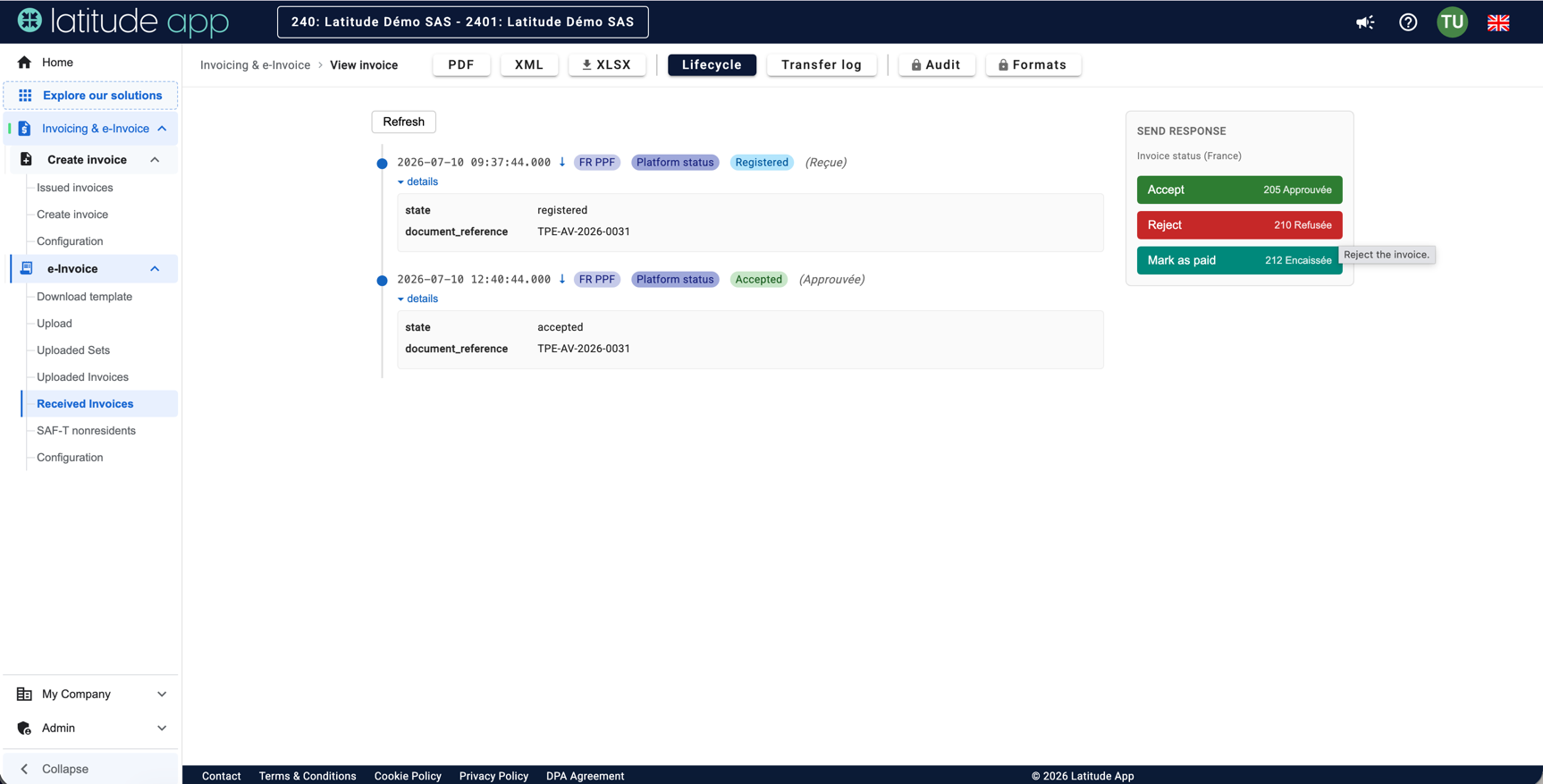
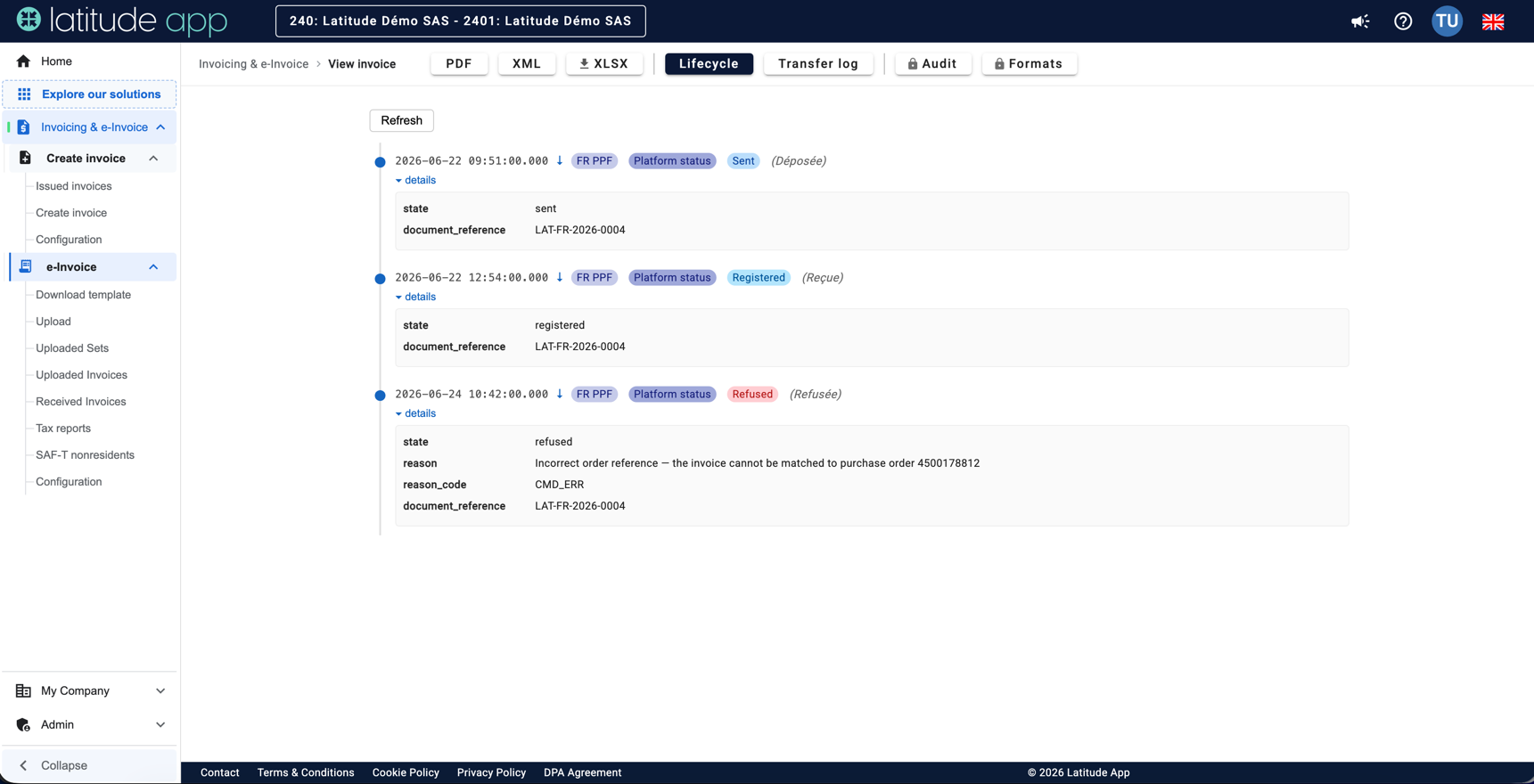
Statuses. Standardised messages that travel back along the same pipes: the invoice was deposited, refused, collected. Some are mandatory. In France they carry legal weight, which is new for most companies.
The flow
Following one invoice
Say you're in Lyon, invoicing a customer in Lille.
- Your system produces the invoice and hands it to your platform
- The platform checks it, and not lightly: France layers its own business rules on top of the European standard, and an invoice that breaks them is stopped before it goes anywhere
- It looks up your customer's SIREN in the annuaire, finds which platform serves them, and delivers it there; the customer's platform passes it into their accounting system
- Along the way, the invoice data reaches the tax authority through the PPF; neither you nor your customer does anything for that, and it is the reason the reform exists
- Then the return journey begins: received, then approved, or refused with a reason code from an official list; for services, a payment status follows when the money actually arrives, because that's when the VAT becomes due
This is the part that surprises people: an invoice is no longer something you send and forget. It's a short conversation, and both halves of it are recorded.
E-reporting
e-reporting, in plain terms
E-invoicing only covers domestic B2B. The tax authority wants visibility over the rest of your activity too, and that's what e-reporting is: periodic transmissions of data about transactions that never produce an electronic invoice. Three kinds of data fall under it.
Sales to consumers
A restaurant or a shop doesn't issue an electronic invoice per customer, but it reports its takings.
Cross-border transactions
Sales to companies abroad and purchases from them, outside the domestic mandate.
Payment data for services
When an invoice is actually collected. This one exists because VAT on services becomes due on payment rather than on invoicing, so the authority needs the date the money moved.
How often you transmit depends on your VAT regime: a company filing monthly reports more often than one under the simplified regime, which is why your regime is one of the details a platform asks for when you're onboarded. A word about where this data comes from. E-reporting is only automatic for what already flows through your platform. Invoices you issue and receive electronically are covered by definition. Consumer sales are not: that data lives in your till system or your ERP, and it has to get to the platform somehow. If someone tells you e-reporting is simply "handled" once you sign, ask them that question specifically.
The calendar
Dates
This calendar has moved before: the original plan started in 2024 and was pushed back, so it's fair to ask whether it will hold. The reception deadline is the one that has survived every revision, and it's also the one that requires the least from you.
Everyone receives
Every company established in France must be able to receive electronic invoices through a registered platform. Large companies and mid-sized ones (ETI) must also issue them, and start e-reporting.
The rest issue too
Small and micro companies must issue and e-report as well.
Chorus Pro continues
Invoicing to the public sector doesn't change: Chorus Pro continues as it has since 2020, alongside the new system rather than inside it.
Penalties, capped but tripled in 2026
Fifty euros per invoice not issued electronically, five hundred per missing e-reporting transmission, each capped at €15,000 a year; the 2026 finance law tripled the original amounts and added a separate sanction for companies that fail to pick a reception platform. The real exposure still isn't the fine: it's a supplier who can't invoice you, or a customer whose platform refuses what you sent.
The solution
Where we come in
We are not a plateforme agréée ourselves. We work with a registered platform, and what we build is everything on your side of it: getting invoices out correctly, getting them back in usable, and keeping the record.
Onboarding happens inside the app
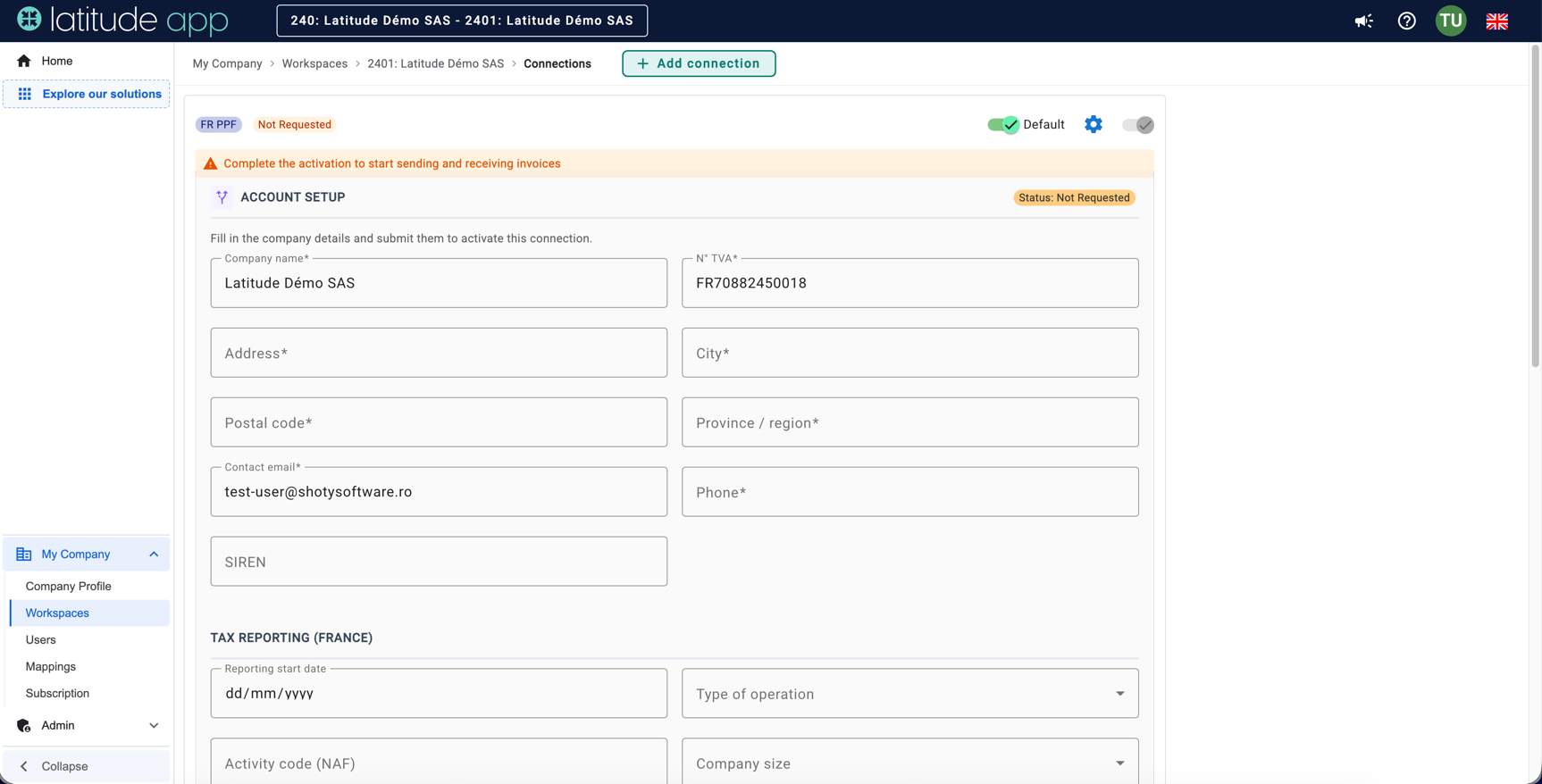
Registering your company, entering the directory and configuring your e-reporting profile (activity type, company size, VAT regime) are steps in one guided flow, and activation doesn't complete until all of them are done. That last point is deliberate: it isn't possible to end up connected for invoicing but silently unconfigured for e-reporting.
Validated against the French rules before sending
Outgoing invoices are checked against the same BR-FR business rules the platforms enforce, so formal refusals get caught on your screen rather than in your customer's system.
Incoming invoices arrive in seconds
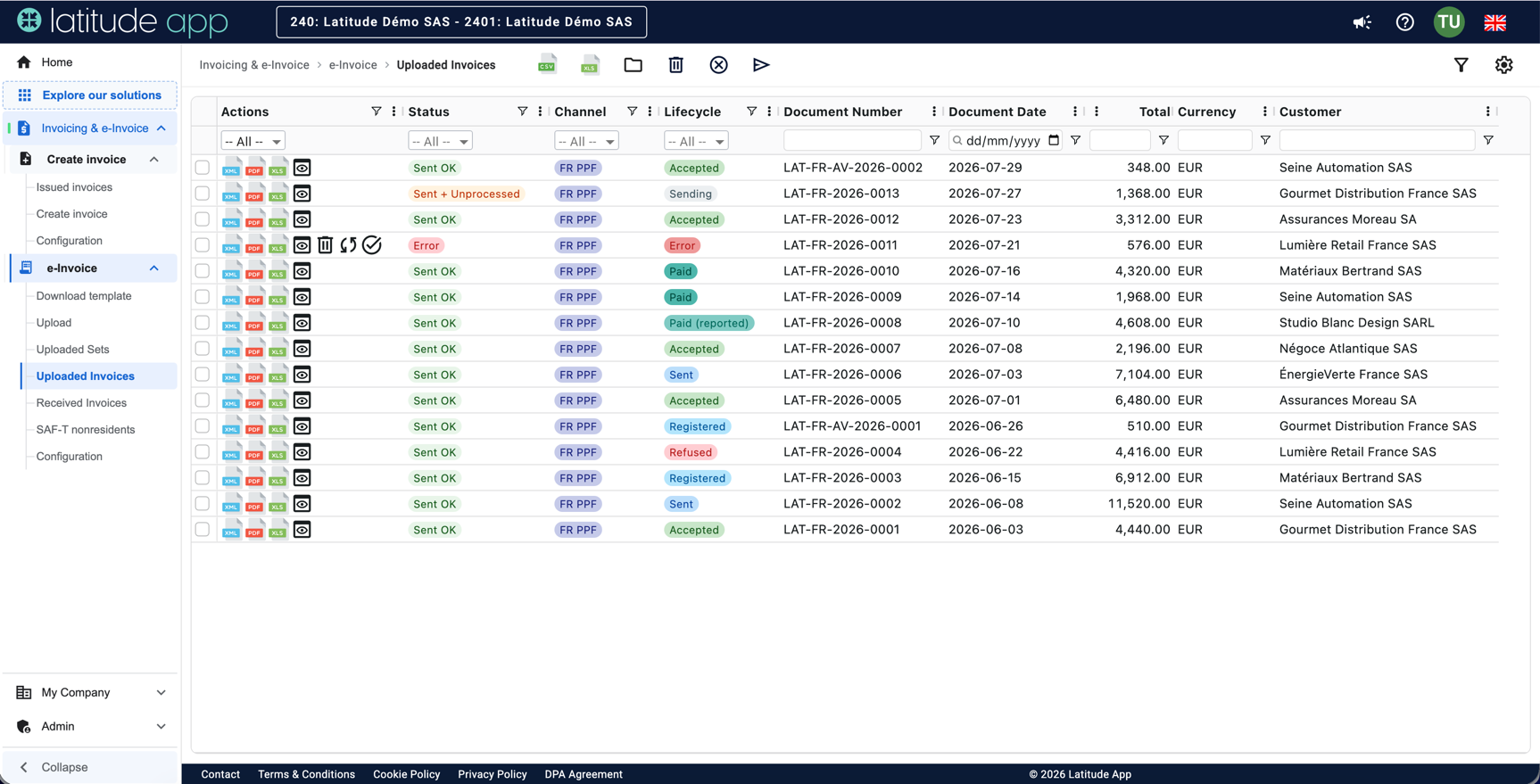
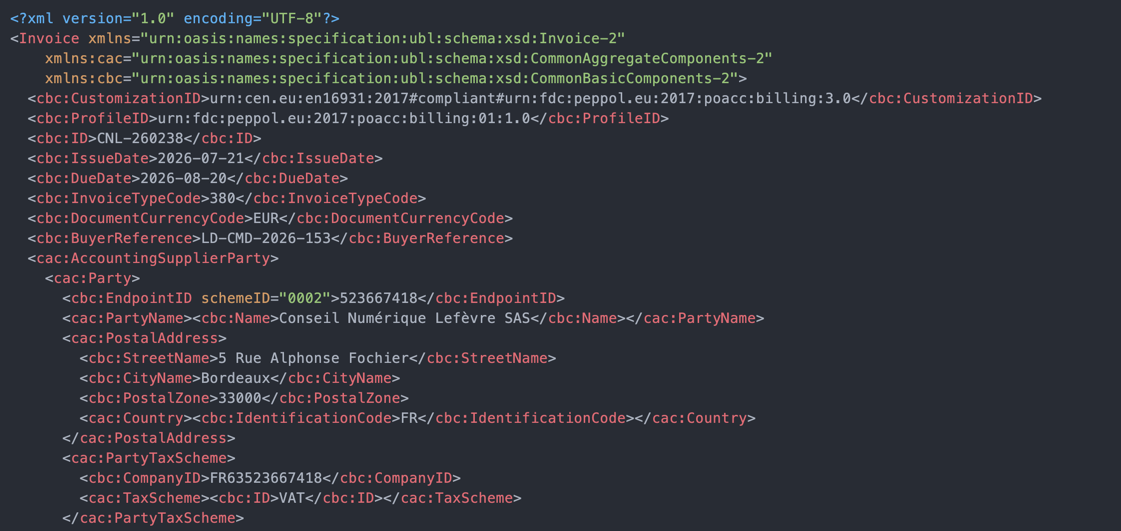
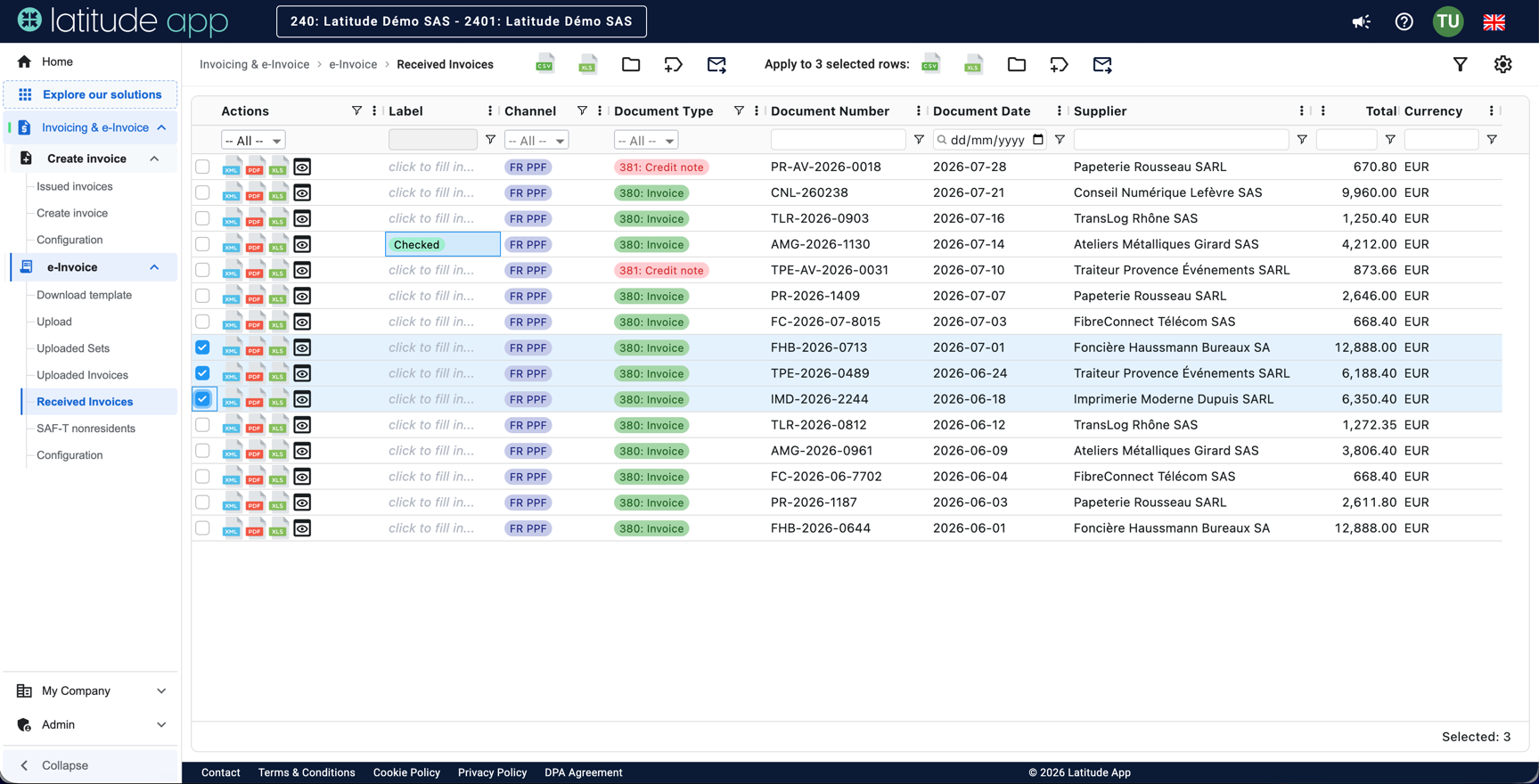
Pushed to us by the platform as they land, with a scheduled sweep behind it in case a notification is ever missed. Each one is readable as PDF or Excel without opening the XML, and the official delivered file is kept exactly as received.
The status conversation, in one place
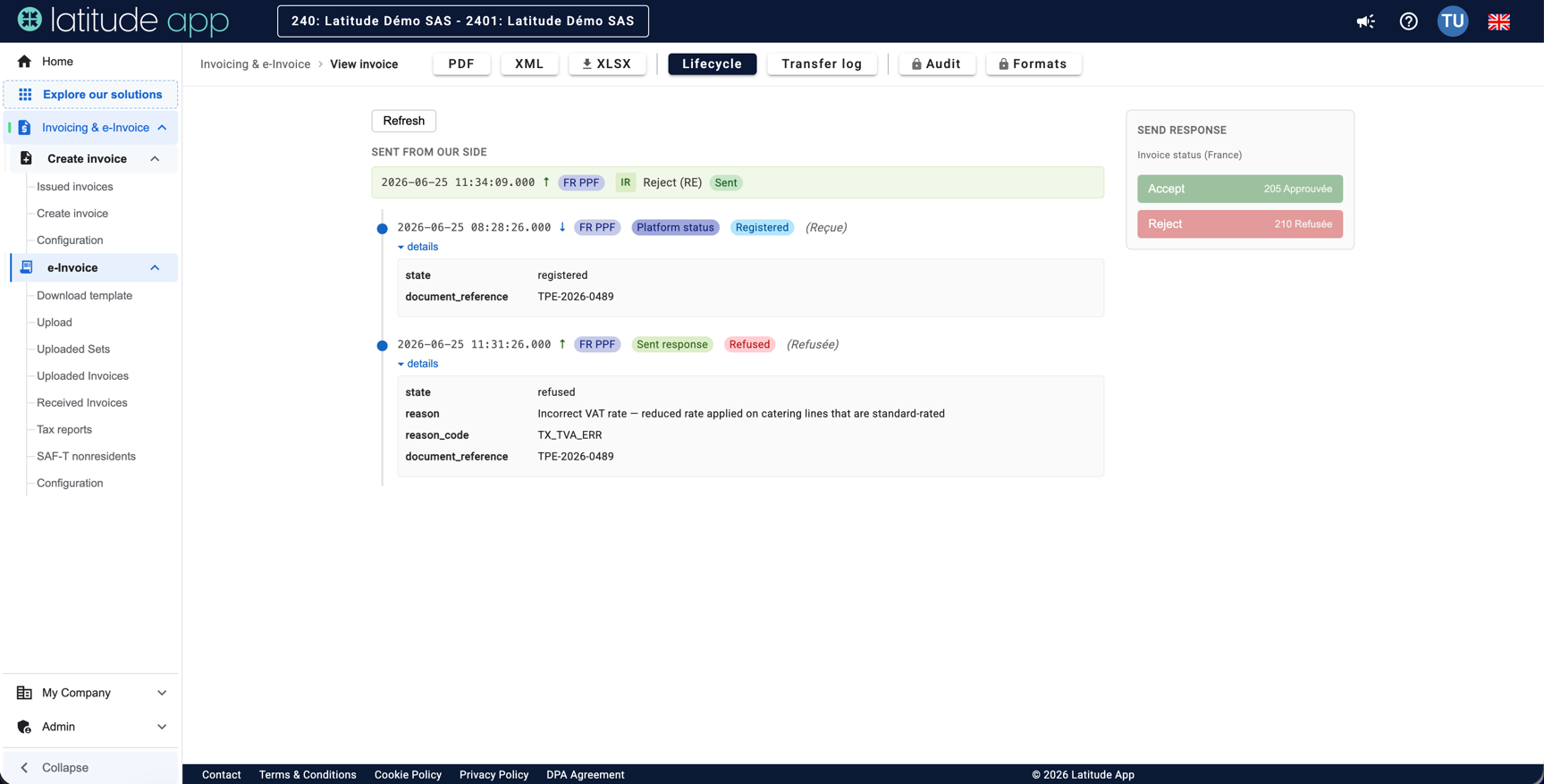
Statuses your customers send back are recorded on each invoice with the French terms alongside. On invoices you receive, you can accept or refuse with the official reason code from the DGFiP vocabulary, from a wrong order reference to an incorrect VAT rate, without leaving the invoice.
Built for groups
The same platform runs Romanian e-Factura, Italian SDI, and Peppol for Belgium and Germany through our own Access Point, covering 24 European countries in total. One login, one way of working, different rails underneath.
Three formats, and why you don't have to choose
The reform accepts three structured formats. Factur-X is a PDF with the invoice data embedded inside it, so a human sees a normal document and a machine reads the structured part; it's popular in France precisely because it doesn't force anyone to give up the readable page. UBL and CII are pure XML, in the two international syntaxes, each with a French profile that adds the legal mentions French law requires.
Your platform translates between them, so you don't have to negotiate a format with each trading partner: you work in one, they work in another, and the conversion happens in transit. What you should care about is that the file your customer legally received is preserved somewhere, exactly as delivered, in case anyone ever disputes what was sent.
Inside the app
What it looks like in Latitude App
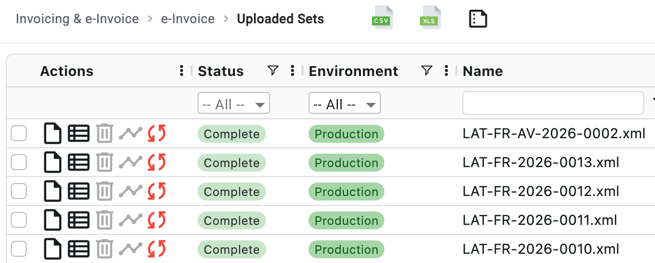
Real screenshots from the "Latitude Démo SAS" demo workspace.
We only receive invoices. Do we really need a platform?
Yes, and this is the most common misunderstanding about the reform. From September 2026 your suppliers are obliged to invoice you electronically, and they can only do that if you're in the directory with a platform behind you. Being small doesn't exempt you; it only delays the obligation to issue.
Can we use the public portal instead of paying for a platform?
Not any more. That was the original design, and it was abandoned in 2024. The PPF kept the directory and the tax-data role, and exchange was left entirely to registered private platforms.
Which format should we adopt?
Whichever your systems produce most naturally. Platforms convert between the three legal formats, so this is a smaller decision than it looks, and a poor reason to delay choosing a provider.
What happens when a customer refuses an invoice?
They select a reason from an official list: wrong order reference, incorrect VAT rate, duplicate, and so on, and that code comes back to you attached to the invoice. It's more useful than it sounds: disputes start from a stated reason instead of a phone call, and the correction is usually obvious.
Is e-reporting really automatic?
For invoices flowing through your platform, yes. For consumer sales, no: that data has to reach the platform from wherever it lives today, usually your till or ERP. Anyone who tells you otherwise hasn't thought about where the numbers come from. We'll go through this with you before you sign, not after.
We're a foreign group with a French subsidiary. What applies?
The French entity follows the French calendar, on its own platform, in the directory under its own SIREN. With us it sits alongside your other European entities, sharing users and approval rules while each country keeps its own connection.
How long does onboarding take?
Registration and directory entry are quick: days rather than weeks. What takes longer is the part specific to you: how your invoices leave your ERP, who approves what, and where your non-invoiced sales data will come from for e-reporting. That conversation is worth having early, which is the main argument for not waiting until 2026.
This article is for information purposes only and does not constitute tax or legal advice. French e-invoicing rules may change and the timeline may be adjusted by decree; the information reflects the situation at the date of the last update.
Beyond France
The same platform, across 24 European countries

Romania · e-Factura
Full ANAF clearance integration on the same platform.
Read the guide →
Italy · SDI
FatturaPA in and out, with notification handling.
Read the guide →
Belgium · Peppol mandate 2026
Structured exchange over Peppol, through our own Access Point.
Read the guide →
Germany · B2B mandate 2025–2028
XRechnung and Peppol BIS, received and sent from the same login.
Read the guide →Testimonials
What our clients say
Real feedback from companies across Romania and international clients using Latitude App for tax compliance.
Want a process this simple too?
Book a demo
Gabriel Băluță
Senior Accountant
Banking
Société Générale Global Solution Centre SA
Latitude App is very useful, reliable, and user-friendly. We integrated the app with our ERP for incoming and outgoing invoices and automated e-Invoice transfer with SPV, which helped us comply more easily with legal requirements and improve process efficiency.

BrandSafway Shared Services SRL
GL Team Leader
Support Services
Latitude App is incredibly user-friendly, intuitive, and customer-focused. Its intuitive interface helps us provide improved quality services, significantly reduces process times, and makes it an essential tool for our daily operations.
Alstom GCC Romania SRL
Chief Accountant
Shared Services
Latitude App is intuitive, fast, and reliable, handling invoices smoothly while ensuring compliance and saving valuable time through automation. The e-Invoicing app has had a highly positive impact on our organization by reducing manual effort, minimizing errors, accelerating financial workflows, and strengthening audit readiness.

Morar Elena-Mihaela
Construcții
Hunnebeck Romania SRL
Latitude App simplifies the invoicing process and makes day-to-day operations easier to manage. The application is intuitive, quick to learn, and provides exactly the functionality our team needs to efficiently manage electronic invoicing requirements.












Start with the questions, not the contract
Most companies we talk to have the same three: which platform, what it means for our ERP, and what e-reporting will actually require from us. We're happy to answer those even if you end up going elsewhere.