Real-time budget control: a guide for the CFO
2026-06-09 Ask any CFO what the worst moment of the month is, and you will often get the same answer: the close. Not because there is a lot of work, but because that is when the surprises show up.
A CFO's real problem is not a lack of discipline in the company. It is a lack of timing. The numbers reach them after the decision has already been made, not during it. And a budget you see after the money is spent is no longer a control instrument. It is just a report.
The anatomy of an approval workflow that actually works
2026-05-27 On paper, almost any approval workflow looks good. The request starts from whoever needs it, climbs the hierarchy, gets approved, turns into an order. The diagram is clean. The problem is that reality does not follow the diagram.
An approval workflow is not judged by how it looks when everything goes well. It is judged by what happens when someone is on leave, when a request is urgent, when the value is so small that three approvals are a joke.
Procure-to-Pay by Latitude App: more control, less friction in the procurement process
2026-05-19 Procurement is no longer just an administrative function. In growing companies, it becomes a key control point for how budgets are protected, how approvals move, and how spending decisions are made before costs reach accounting.
As business operations become more complex, purchase requests, approval flows, supplier orders, budgets, departments, projects, and analytical dimensions need to work together in one clear process. When procurement is managed through emails, spreadsheets, manual follow-ups, and disconnected files, teams lose time, visibility, and control.
Latitude App achieves Peppol accreditation, expanding cross-border e-Invoicing capabilities across 24 European countries
2026-03-01 Digital invoicing in Europe is no longer just a compliance requirement. It’s becoming the backbone of how businesses trade across borders. With mandatory e-Invoice frameworks expanding across the EU, companies need solutions that are not only locally compliant but internationally connected.
That’s why the Peppol accreditation marks a significant milestone, both for us and for the companies relying on our platform.
Peppol is a secure international network that enables standardized electronic document exchange, including e-Invoices, between businesses and public institutions across Europe and beyond.
Being Peppol accredited means that Latitude App:
Can securely exchange structured e-Invoices through the Peppol network
ABC in Entrepreneurship III: Entrepreneurs' fears about RO e-Invoice and how to reduce them
2026-02-15 One of the most common questions entrepreneurs ask their accounting teams is: "What should I do to avoid fines?" It's a fair question, and it highlights an essential truth: fiscal compliance requires discipline, structure, and a clear understanding of the rules. In a constantly changing regulatory landscape, this responsibility often feels like a heavy weight for company decision-makers, especially in finance and accounting.
Many business owners design their compliance strategies around the risk of penalties. In other words, the fine system becomes their compass for action. Let's look at what steps you should take as an RO e-Invoice user to minimize the risk of non-compliance and maintain control over your fiscal obligations.
Step one: Use the grace period wisely
Don't wait until the grace period ends to align with the rules. While postponing implementation may be tempting, it's not a sustainable approach.
ABC in Entrepreneurship II: Steps toward fiscal digitalization
2026-01-20 The world of entrepreneurship is, without a doubt, one of the most dynamic and challenging environments. Every decision, legislative change, or step toward digitalization can directly shape the trajectory of a business. That's why the "ABC in Entrepreneurship" guide, created to help business owners better understand the path to compliance and fiscal efficiency, continues today with a new stage: RO e-Invoice, Stage II.
ABC in Entrepreneurship I: RO e-Invoice, the first step toward fiscal digitalization
2025-12-15 The recent transformations in the Romanian business environment are pushing more and more entrepreneurs toward digitalization. Among the changes with the greatest impact are those related to fiscal digitalization. For many companies, RO e-Invoice is the entry gate into this new and complex universe.
Initially met with scepticism, the RO e-Invoice system has become an essential pillar in modernizing the interaction between businesses and the state. For many entrepreneurs, it represented their first real contact with an official digital tool for fiscal reporting. Although adaptation hasn’t always been easy, the gradual introduction of mandatory use has helped more companies understand the benefits of automation and transparency.
From Rumour to Reality: How the system was received
High fiscal risk goods: what must be declared and when
2025-11-10 When it comes to tax compliance, not all goods are treated equally. In Romania, certain categories of products have been flagged as high fiscal risk, a classification based on product categories historically associated with tax evasion, underreporting, or fraudulent trading practices. To tighten control, these goods fall under the mandatory monitoring of the RO e-Transport system, and they are specifically listed in Order No. 802/2022 for the establishment of high fiscal risk goods transported by road that are subject to monitoring through the RO e-Transport System.
But what exactly qualifies as high-risk? And when are you required to declare it?
Discover what are the fines for RO e-Transport noncompliance
2025-10-20 If you’re handling goods in Romania, failing to comply with RO e-Transport regulations can lead to serious financial penalties and even confiscation of the value of your goods. The penalties are structured by the type of violation and the category of the legal entity (individual vs. company). Even more seriously, repeated offenses can trigger progressive penalties and confiscation of the value of the undeclared goods. So, whether you’re a logistics operator, importer, exporter, or a warehouse manager, understanding these rules is important.
The most common noncompliance scenarios include
Failing to declare local or international transports of high-risk goods in the RO e-Transport system
Failing to declare international transports of regular goods in the RO e-Transport system
Who has the obligation to submit RO e-Transport declarations
2025-10-05 With the implementation of the RO e-Transport system, a broad range of businesses and entities operating in Romania are required to declare road transport data for regular or high fiscal risk goods. The obligation isn’t limited to transport companies, it applies to several other economic actors involved in supply chains, whether goods move domestically or across borders.
If you buy, sell, import, export, store, consolidate, split, or move regular or high-risk goods, you could be legally responsible for submitting transport data to the Romanian tax authority (ANAF) through the RO e-Transport platform.
What you need to know about upcoming fines and compliance deadlines of RO e-VAT
2025-09-15 Starting July 1, 2025, a new chapter begins in VAT compliance for Romanian taxpayers. With the introduction of the RO e-VAT system, businesses will need to adapt quickly to stricter rules, tighter deadlines, and potentially significant fines. The e-VAT system, designed to automate and streamline VAT reporting, also introduces a formalized process for handling discrepancies through RO e-VAT Compliance Notifications.
What is a RO e-VAT Compliance Notification?
If ANAF detects differences between your submitted VAT declarations and the pre-filled data from the e-VAT system, they will issue a compliance notification. From the moment you receive it, you have exactly 20 days to review the flagged discrepancies and submit a justified response.
How to automatically verify customer and supplier data in SAF-T
2025-08-25 When submitting a SAF-T declaration, accuracy is everything – especially when it comes to customer or supplier data. Whether you’re reporting balances, invoices, or payments, everything needs to be correctly matched and reported across all sections. But let’s face it, when data is spread across multiple systems and formats, how can you be sure everything actually lines up?
Let’s break down how customer and supplier information should be reported in SAF-T and how you can automate the verification process to save time and avoid errors.
In each monthly or quarterly SAF-T file, customer and supplier details are distributed across several key sections:
Customers or Supplier – Shows opening and closing balances.
Everything you need to know about SAF-T for non-resident taxpayers
2025-08-10 Starting January 1, 2025, non-resident companies registered for VAT purposes in Romania are required to submit the SAF-T (Standard Audit File for Tax) declaration. The good news? The version for non-residents is simplified, making the reporting process much more manageable. Here’s a clear breakdown of what non-resident businesses need to know to stay compliant
What does the non-resident SAF-T look like?
Non-resident taxpayers will submit a more streamlined SAF-T declaration, which covers the essentials:
Declaration Header – Basic company information, including taxpayer details, contact information, and the reporting period.
Product List – A list of traded goods, including tariff codes and units of measurement.
How to automatically verify that VAT information reported in the SAF-T declaration is accurate
2025-07-20 Important Update – New SAF-T VAT Codes Effective August 1, 2025
The standard 19% VAT rate, along with the reduced 5% and 9% rates, are being replaced by new rates of 11% and 21%. This change directly impacts the SAF-T VAT codes used in your XML declarations.
To support a smooth transition, we’ve prepared a Correspondence Table between the old SAF-T VAT codes and the new ones required starting 01.08.2025, ensuring you’re mapping transactions correctly and avoiding inconsistencies that could trigger errors or rejections in your SAF-T filings.
Download the SAF-T VAT Code Correspondence starting with 01.08.2025 and review your SAF-T mappings before your next declaration.
SAF-T declaration: understanding what it is and what are its main challenges
2025-07-05 Since January 2022, businesses in Romania have been required to submit a new type of report to ANAF, the SAF-T Declaration (406). This report goes beyond just tax data, also covering accounting details and management information, giving authorities a clearer picture of a company’s financial activity.
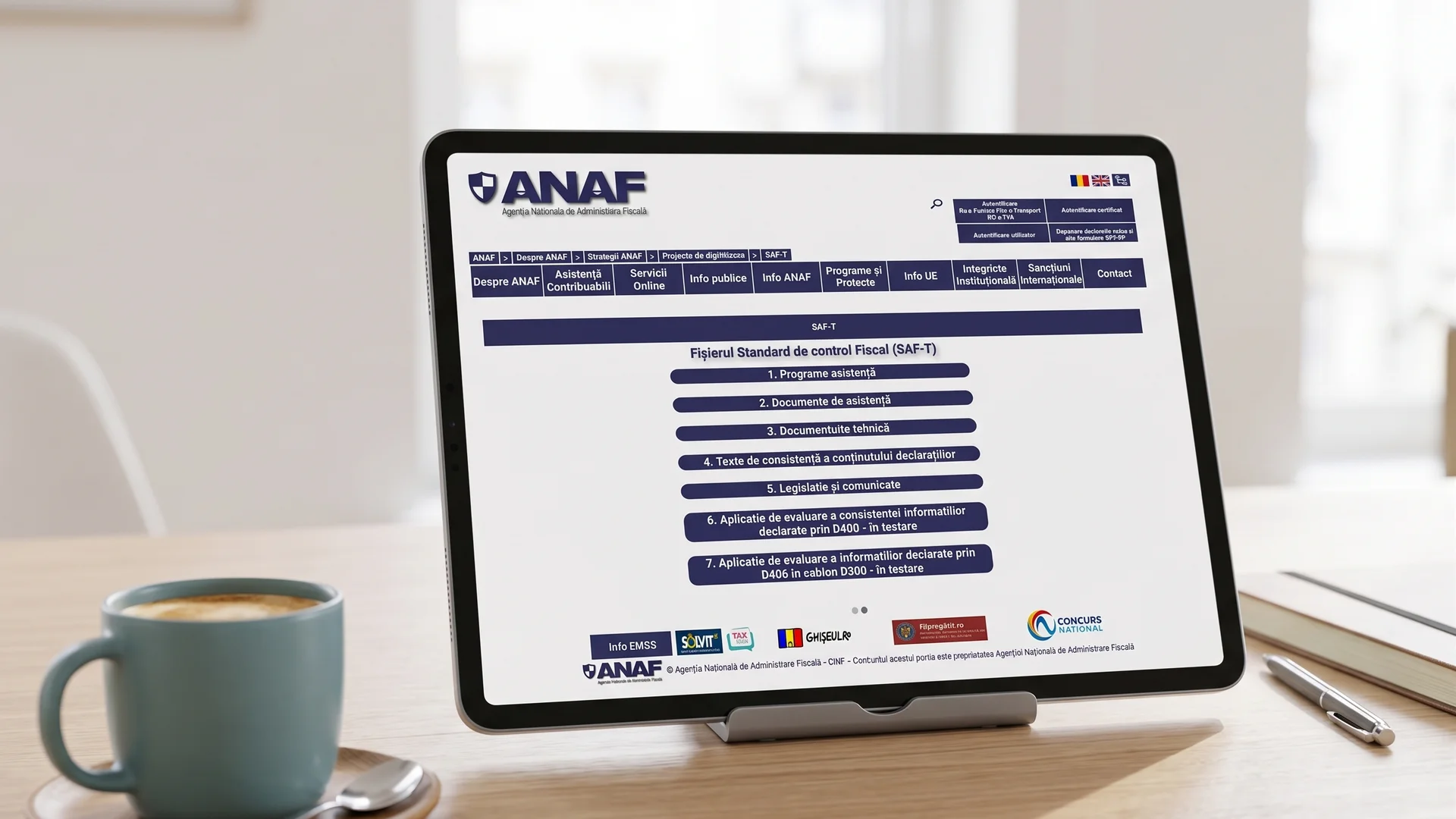
SAF-T stands for Standard Audit File for Tax, an international standard designed to streamline the electronic exchange of financial data between businesses and tax authorities. Its main goal is to give ANAF better visibility into business operations while making tax audits more efficient, accurate, and data driven.
There are three types of SAF-T declarations:
Monthly or quarterly SAF-T declaration (depending on the taxpayer’s reporting period)
How to avoid ANAF notifications for inconsistencies in your SAF-T declaration
2025-06-15 Submitting a SAF-T declaration can be a complex process. Even if your submission clears the DUK Integrator validation, ANAF may still flag inconsistencies, triggering notifications that result in extra work, stress, and a ticking 30-day deadline to make corrections. However, by proactively verifying your declaration before submission, you can catch potential issues early and avoid these notifications altogether.
e-VAT: A comprehensive guide to simplifying VAT reporting with RO e-VAT
2025-06-01 Romania’s journey into financial digital transformation is gaining momentum, and the RO e-VAT system is at the heart of this transition. While the goal is to make VAT reporting more efficient and compliance easier, this new system does come with its own set of challenges. It’s not all smooth sailing; there’s a bit more work involved, and the changes will take time to get used to. But how does it work, and what can companies do to stay ahead? Let’s break it down, and explore the key aspects of this system, the legislative framework behind it, and how tools like Latitude App can help businesses adapt seamlessly.
The implementation of the RO e-VAT system is governed by the following major legislative acts:
SAF-T obligations and terms for newly added taxpayers on the lists of large and medium taxpayers
2025-05-15 The taxpayers included by the tax authorities on the lists of large and medium taxpayers had the obligation to report SAF-T in stages, starting with January 2022, according to the chart below published by ANAF.
Small taxpayers and non-resident companies registered for VAT purposes in Romania will have the obligation to report SAF-T starting from January 2025.
Small taxpayers, who until January 2025 are reclassified by ANAF as large or medium taxpayers, will have the obligation to report SAF-T starting with the date of their inclusion on the lists of large and medium taxpayers.
RO e-Invoice: mandatory electronic invoicing system - who, when and how must issue electronic invoices
2025-04-20 Who has the obligation to issue and send e-Invoices?
The obligation to issue electronic invoices and to transmit them through the national RO e-Invoice system rests with:
Economic operators that sell products with high fiscal risk in the B2B (Business to Business) relationship
The list of products with high fiscal risk is detailed in OPANAF no. 12/2022 and includes the following product categories:
Vegetables, fruits, edible roots and tubers, other edible plants (CN codes from 0701-0714; CN codes from 0801-0814);
Alcoholic beverages (CN codes from 2203-2208);
The first deadline for submitting the D406 annual statement regarding fixed assets is approaching. Are you ready?
2025-04-01 For certain categories of taxpayers, the first deadline for submitting the D406 Annual Declaration regarding fixed assets (“Annual D406 Assets Declaration”) is approaching.
The general rule for establishing the deadline for submitting the annual D406 Declaration regarding assets is that this deadline is the same as the deadline for submitting the financial statements related to the financial exercise for which the SAF-T reporting on assets is being prepared.
For example, for the financial year 2022, the deadline for submitting the annual Declaration D406 regarding fixed assets is May 30, 2023. This deadline is starting to become quite urgent, especially in the context in which certain taxpayers are still working on the preparation of this declaration.
What does the SAF-T declaration (Declaration 406) contain
2025-03-15 The RO SAF-T declaration (declaration 406) contains four main sections, each of these sections presenting one or more subsections. SAF-T sections and subsections may have different reporting periods:
Who must submit the RO SAF-T declaration (Declaration 406)
2025-03-01 The SAF-T declaration (declaration 406) must be submitted by all taxpayers, Romanian legal entities or non-resident legal entities that carry out activity in Romania through a permanent establishment or that have a registration code for VAT purposes in Romania or the place of effective management in Romania.
The deadlines from which taxpayers will submit the SAF-T declaration depend on the size of the taxpayer (read also When does the obligation to submit the SAF-T declaration (declaration 406) and What are the deadlines for the SAF-T declaration (declaration 406).
Since when does the mandatory submission of the RO SAF-T declaration come into effect
2025-02-20 The obligation to submit the RO SAF-T declaration (declaration 406) becomes effective for each taxpayer depending on their category:
taxpayers included in the category of large taxpayers on January 1, 2022, who were also part of this category in 2021, have the obligation to report SAF-T starting on January 1, 2022
taxpayers included in the category of large taxpayers on January 1, 2022, who were not part of this category in 2021, have the obligation to report SAF-T starting on July 1, 2022
taxpayers classified as medium taxpayers on 01.01.2023, have the obligation to report SAF-T starting from January 1, 2023
the rest of the taxpayers who do not fall into any of the categories above, have the obligation to report SAF-T starting January 1, 2025
What are the deadlines for the RO SAF-T declaration (Declaration 406)
2025-02-10 The SAF-T statement (statement 406) includes three types of reports, each with different deadlines
Periodic SAF-T reporting: the deadline for submitting the periodic SAF-T declaration is until the last day of the month following the reporting month (in the case of monthly reporting) or until the last day of the month following the reporting quarter (in the case of quarterly reporting).
The SAF-T reporting period, monthly or quarterly, is applied depending on the VAT reporting period of each taxpayer:
Taxpayers who report monthly VAT will also report monthly SAF-T
Taxpayers who report quarterly VAT will also report quarterly SAF-T
Taxpayers not registered for VAT purposes will report quarterly SAF-T
What is the grace period for the SAF-T declaration (Declaration 406)
2025-02-01 For submitting the periodic RO SAF-T declaration (monthly or quarterly), taxpayers benefit from a grace period of maximum 6 months for the first reporting months/quarters.
Taxpayers who have the obligation to submit the monthly SAF-T declaration can benefit from a maximum of 6 months of grace for the first 6 reports:
The SAF-T declaration for the first reporting month can be submitted until the last day of the sixth month after the end of the reporting month (for example, if the SAF-T reporting obligation applies from 01.01.2022, the SAF-T declaration for the month of January can be submitted at any time until on 31.07.2022)
How to resolve notifications about SAF-T declaration inconsistencies reported by ANAF
2025-01-27 Managing SAF-T declarations can be challenging, especially when receiving notifications from ANAF regarding issues and inconsistencies. These notifications often take the taxpayer by surprise, particularly when they involve technical challenges that go beyond standard compliance. This guide is here to help you understand these issues and fix them with confidence.
Understanding ANAF’s two levels of verification
What are the applicable fines for the RO SAF-T declaration
2025-01-15 The contraventions applicable for the SAF-T declaration are those mentioned in art. 337^1 of the Romanian Fiscal Procedure Code:
Failure to submit the standard fiscal control file (SAF-T declaration / declaration 406) by the deadlines provided by law, is sanctioned with a fine between 1,000 lei – 5,000 lei
Incorrect or incomplete filing of the standard fiscal control file (SAF-T declaration / declaration 406), is sanctioned with a fine between 500 lei – 1,500 lei