Guide · E-invoicing in Belgium
 E-invoicing in Belgium: from you to your customer in seconds
Since 1 January 2026, invoices between Belgian businesses are structured e-invoices exchanged over the Peppol network: PDFs and paper no longer count. Latitude App is a certified Peppol Access Point: issue, receive and track your e-invoices in one modern platform, and let us handle the plumbing.
Updated: 1 August 2026 · 7 min read
- Certified Peppol Access Point
- Peppol BIS 3.0 / EN 16931 built in
In short
- Since 1 January 2026, businesses established in Belgium must send and receive structured e-invoices for domestic B2B transactions: paper and PDF invoices no longer count between them.
- The default is Peppol BIS 3.0 over the Peppol network (the European EN 16931 standard). Another EN 16931-compliant format is allowed only if both parties agree, and you must still be able to handle Peppol.
- Invoices to the public sector already run on Peppol (via the Mercurius platform), while B2C stays out of scope. The Hermes fallback service retired at the end of 2025.
- Lacking the technical means to issue and receive structured invoices draws graduated fines (€1,500 / €3,000 / €5,000), repeatable at each new finding at least 3 months apart; the administrative tolerance period at the start has ended. From 2028, near-real-time e-reporting follows, on the 5-corner model.
- Latitude App is a certified Peppol Access Point: issue, receive and track every invoice in one platform, with Romania, Italy, Germany, France and, in total, 24 European countries covered by the same product.
Context
What are Peppol and the four-corner model?
Peppol is not a government portal, but an international delivery network for structured business documents, built on certified Access Points. In the four-corner model, you (corner 1) hand your invoice to your Access Point (corner 2), which finds and delivers it to your customer's Access Point (corner 3), which passes it into your customer's system (corner 4). No e-mails, no downloads: system to system, in seconds.
Belgium chose this network as the backbone of its B2B mandate. The invoice itself is an XML document in Peppol BIS Billing 3.0 (UBL), the profile that implements the European e-invoicing standard EN 16931. Between Belgian businesses, a PDF attached to an e-mail is no longer an invoice: the structured file is.
On Peppol, every company is addressed by a participant ID. For Belgian companies that uses scheme 0208: the enterprise number from the CBE/KBO register, which is simply your VAT number without the BE prefix. Your suppliers send to your number and the network looks up where you receive; for Latitude App customers, that is our Access Point. More on that below.
Timeline
Belgium's road to structured invoicing
B2G begins in Flanders
Suppliers to the Flemish government start invoicing electronically over Peppol, through the Mercurius platform.
B2G everywhere
Brussels, Wallonia and the federal level phase in structured invoicing for public contracts of every size.
The B2B law is adopted
The law of February 2024 makes structured e-invoicing mandatory between Belgian businesses, two years ahead of the go-live.
Hermes retires
The transitional service that converted structured invoices into e-mails shuts down on 31 December: Peppol readiness becomes essential.
The B2B mandate is live
From 1 January, domestic B2B invoices between Belgian businesses are structured e-invoices, with Peppol BIS as the default.
E-reporting follows
Invoice data starts flowing to the tax authority in near real time, on the 5-corner model, aligned with the EU's ViDA reform.
The mandate
Who does the mandate cover?
The obligation to issue structured e-invoices covers VAT taxable persons established in Belgium: companies of every size, as well as Belgian branches and fixed establishments of foreign groups, for their domestic B2B supplies. Out of the issuing obligation stay businesses making exclusively VAT-exempt supplies (article 44), those still under the flat-rate scheme (being phased out by 2028) and bankrupt businesses.
The obligation to receive is broader: any business buying under a Belgian VAT number must be able to accept structured e-invoices, including foreign companies that are merely VAT-registered in Belgium. Invoices to private consumers (B2C) remain outside the mandate.
Latitude App accommodates Belgian businesses directly, from a one-person BV all the way to a corporate group. Activation is a few steps: we register your participant ID at our Access Point and you can send your first invoice the same day. No separate Access Point contract, no migration project. And when your business reaches beyond Belgium, the same platform follows.
The flow
How an invoice travels over Peppol
Five steps, fully automated in Latitude App. Follow the invoice:
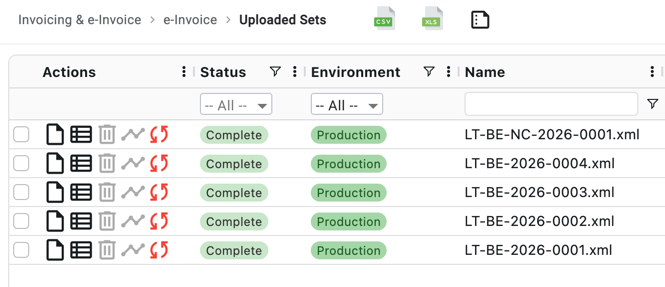
- You issue the invoice in the app, upload your UBL XML, or we connect your system through a custom integration
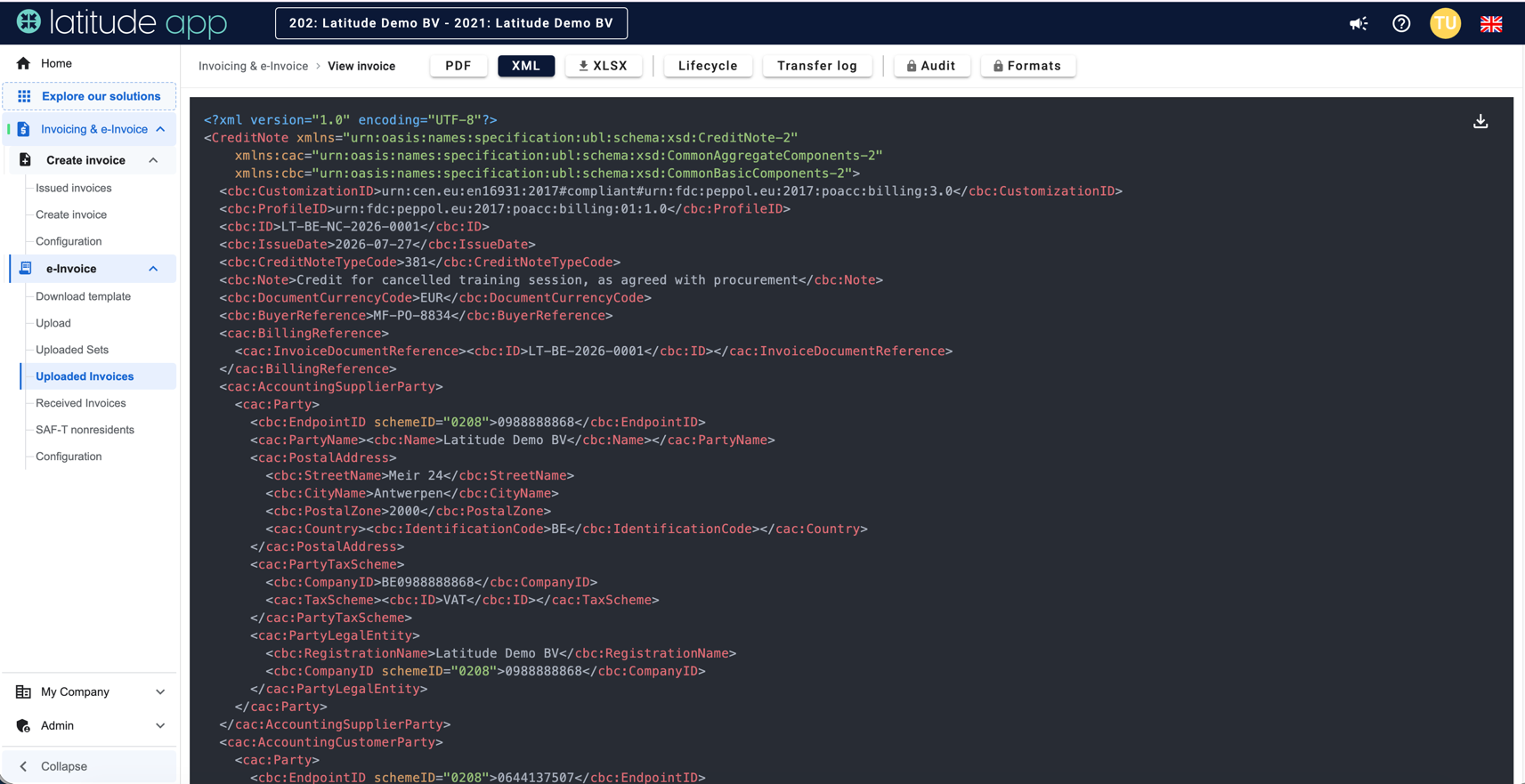
- Latitude App, your Access Point, validates it against Peppol BIS 3.0 before anything leaves
- The network finds your customer's Access Point through the Peppol directory
- Their Access Point validates the message and confirms the hand-over
- The delivery confirmation comes back automatically and the status updates in the platform
Statuses
Peppol statuses, in plain language
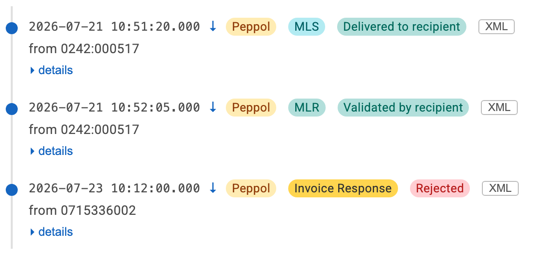
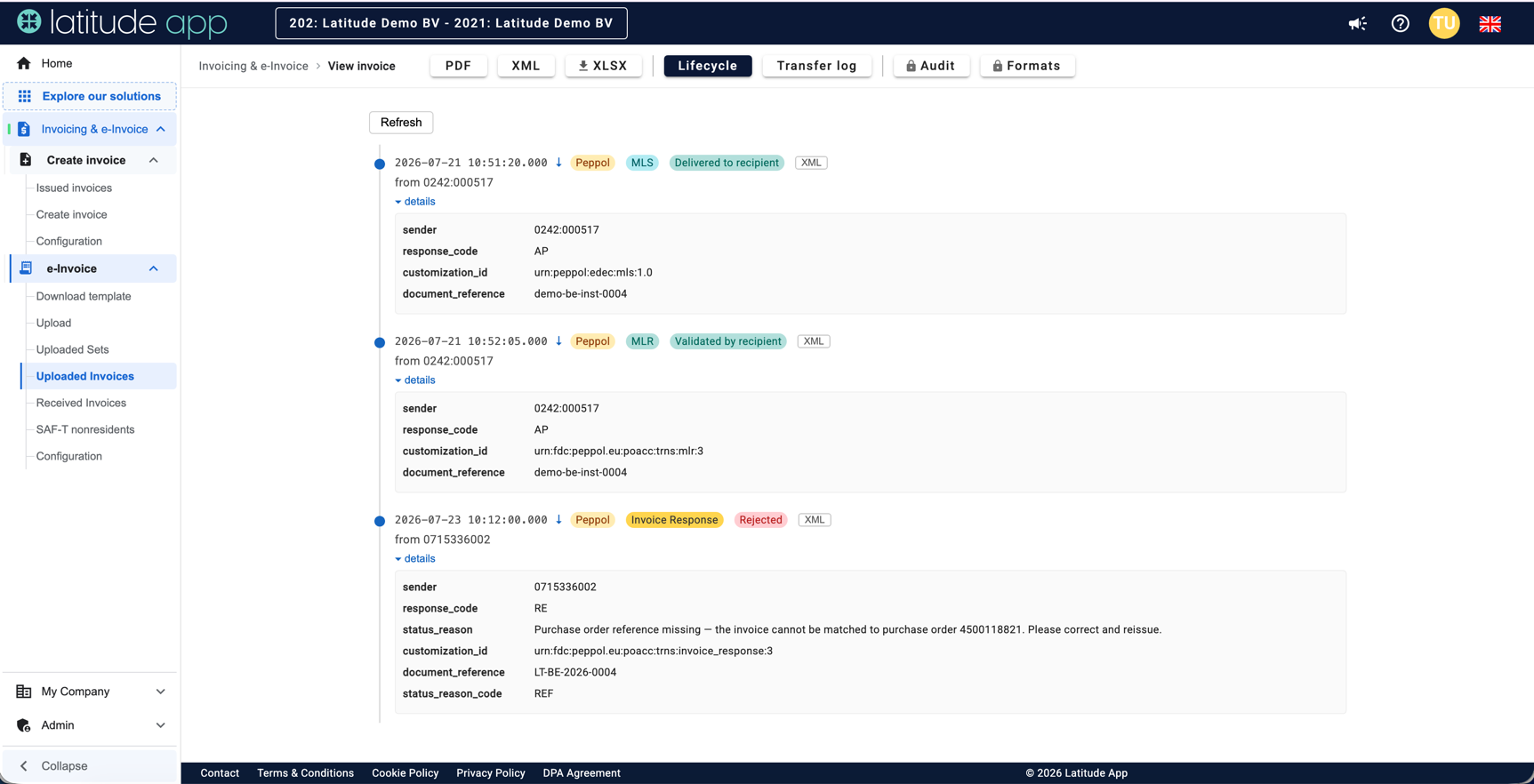
An invoice on Peppol doesn't go quiet after sending: delivery is confirmed at message level, and your customer can answer with a structured business response. In Latitude App each signal becomes a clear status on the invoice, with no XML to decipher.
Delivery confirmation
The network's Message Level Status: proof that your invoice reached the recipient, or an early alert that delivery failed. The newer variant, gradually replacing MLR.
→ in the app: "Delivered to recipient"
Message validation
The receiving Access Point reports whether the document passed its checks on arrival. The older variant, on its way out: an MLS now arrives for every invoice, and some Access Points still send an MLR on top, until its full phase-out from the network in 2027.
→ in the app: "Validated by recipient"
Business response
Your customer's answer, as a structured message: acknowledged, in process, under query, conditionally accepted, accepted or even paid.
→ in the app: "Accepted", "In process", "Under query", "Paid"
Rejected
The customer refuses the invoice and says why. Correct the issue and send a new document, from the same screen.
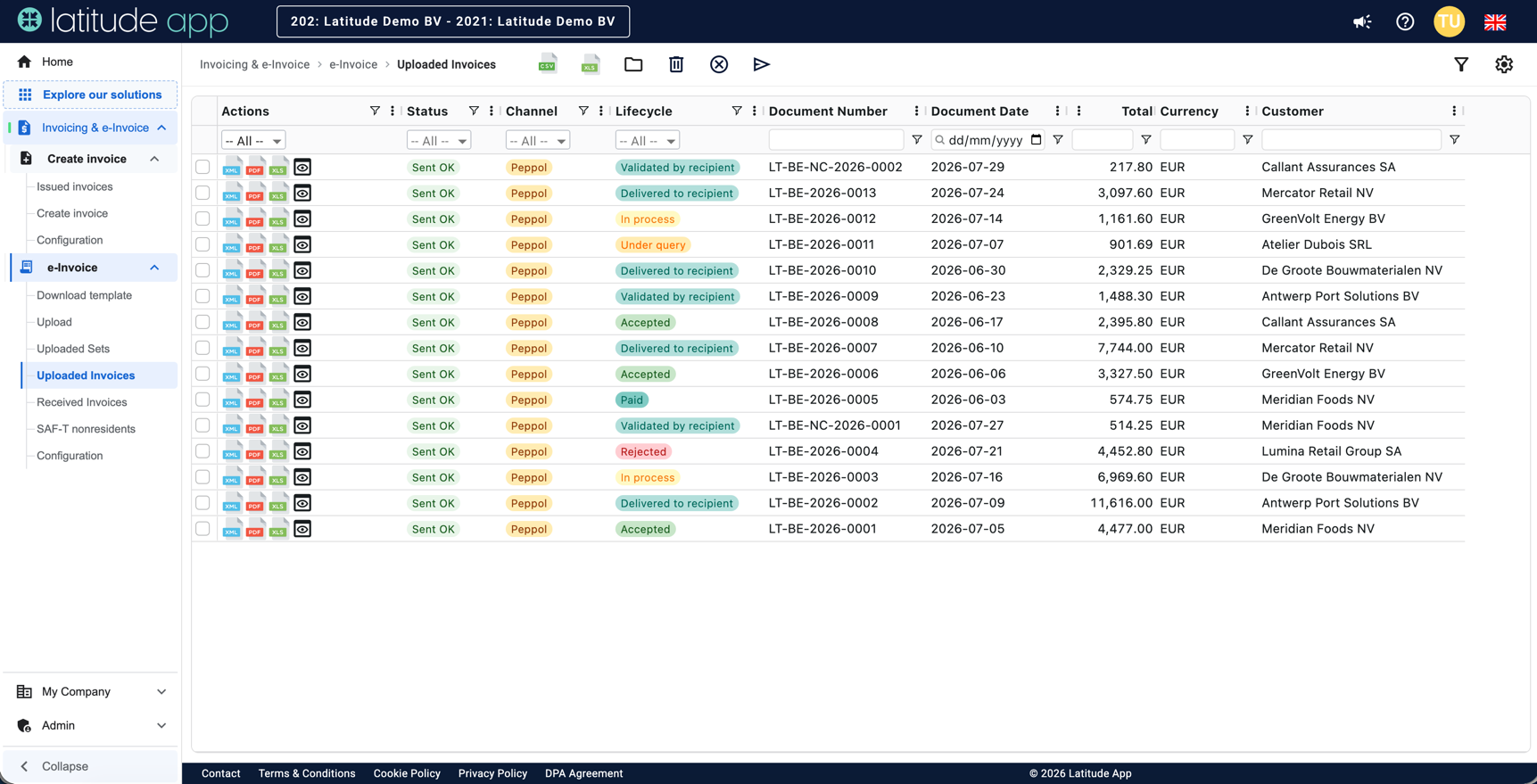
→ in the app: "Rejected", with the reason on the invoice
the year structured B2B e-invoicing became mandatory in Belgium
the fine at the first finding of non-compliance, rising to €3,000 and €5,000
months, the minimum interval between two successive finable findings
near-real-time e-reporting arrives (5-corner model)
The solution
How Latitude App helps
We're not another upload portal: Latitude App is a certified Peppol Access Point, a direct member of the network, wrapped in a platform your whole team can actually use.
Your own certified Access Point
We send and receive over our own certified Peppol Access Point, with no third-party Access Point contract and no intermediaries between you and the network.
No Peppol BIS expertise needed
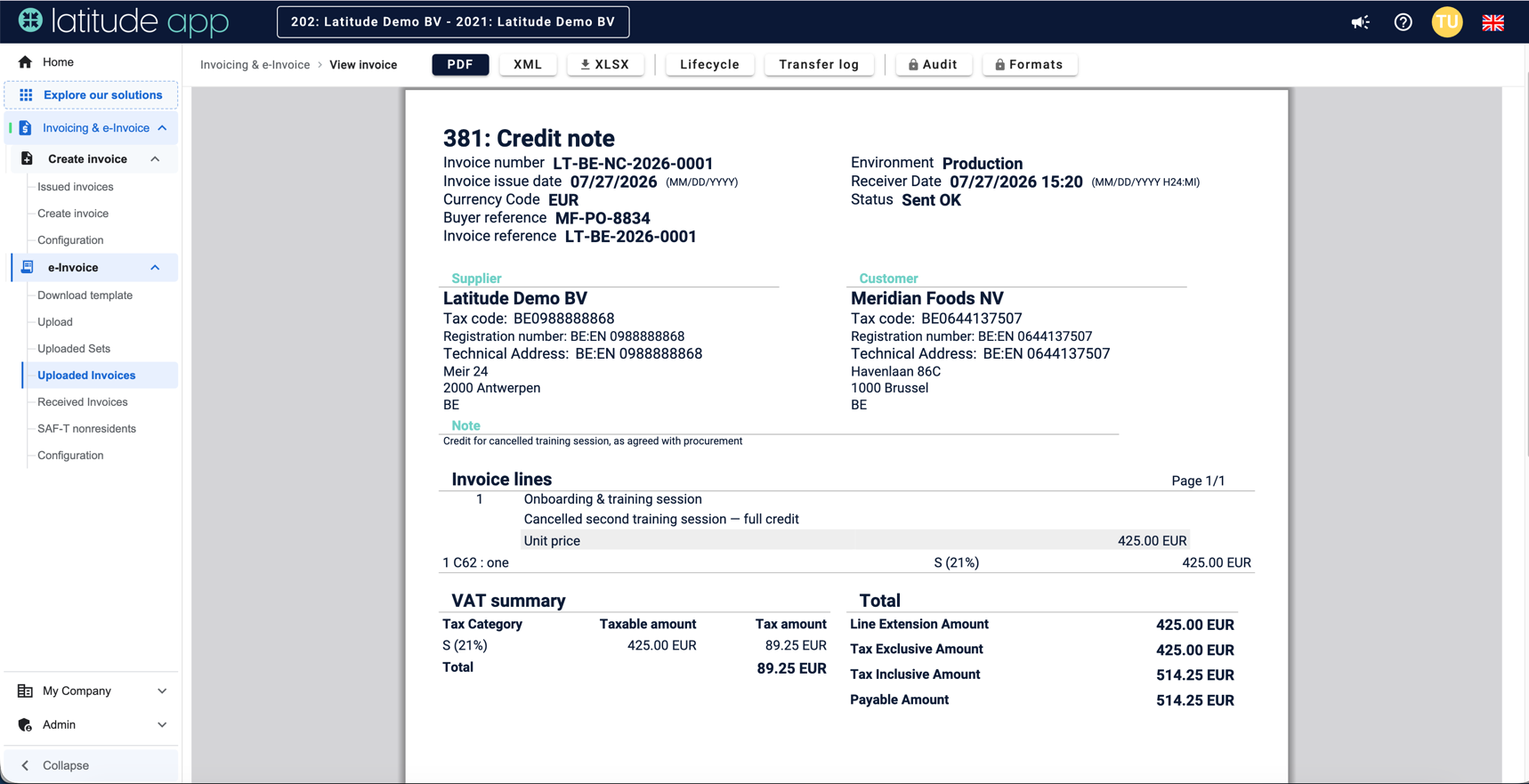
Issue invoices in the app or upload your UBL XML. Validation against Peppol BIS 3.0 and EN 16931 happens automatically, before anything reaches the network. And if your system only exports a proprietary format, we build a custom integration that picks it up automatically.
Real-time statuses, zero limbo
Delivery confirmations, validation results and business responses become clear statuses on every invoice: you always know where each document stands.
Receive on your participant ID
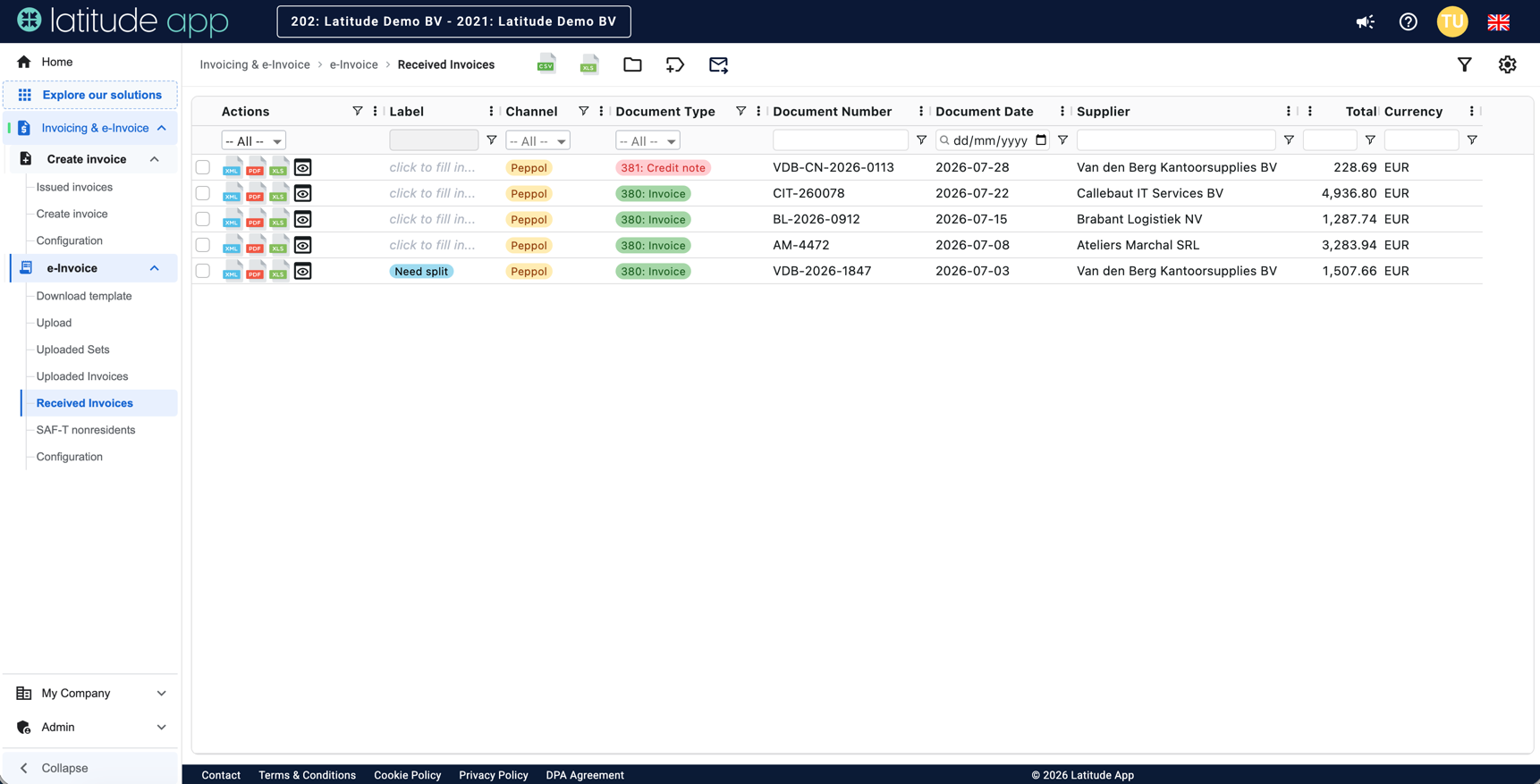
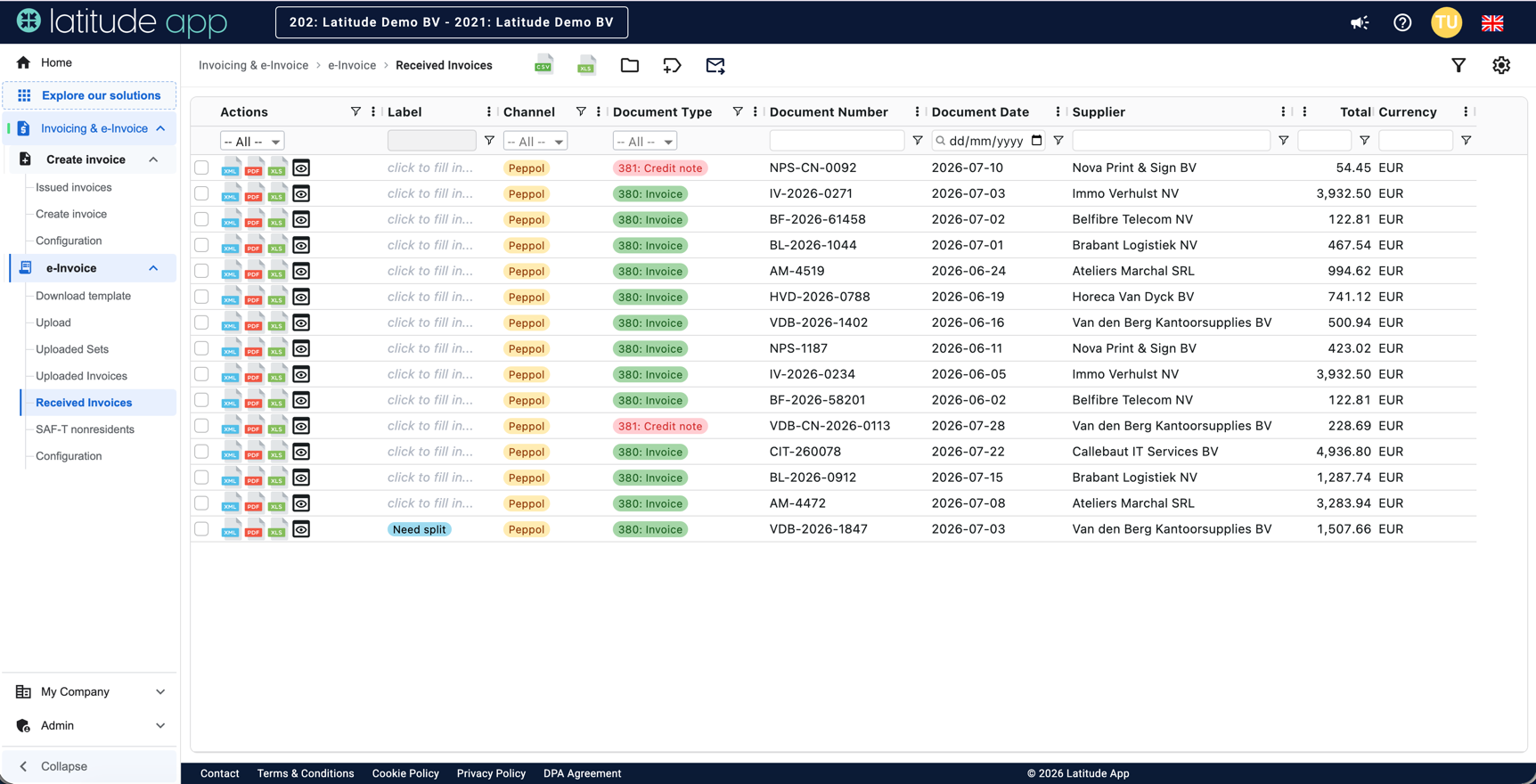
We register your enterprise number on the Peppol network once, and every supplier invoice lands in the platform automatically: the original XML plus a readable rendering.
Answer your suppliers
Approve or reject incoming invoices in the app, and the business response travels back to your supplier over the same network.
Beyond Belgium, same platform
Peppol reaches your customers across Europe, and the same product runs e-invoicing in 24 European countries, including Romania (ANAF e-Factura), Italy (SDI), Germany and France. When your business crosses borders, your invoicing doesn't have to fragment.
One identifier, reachable by every supplier
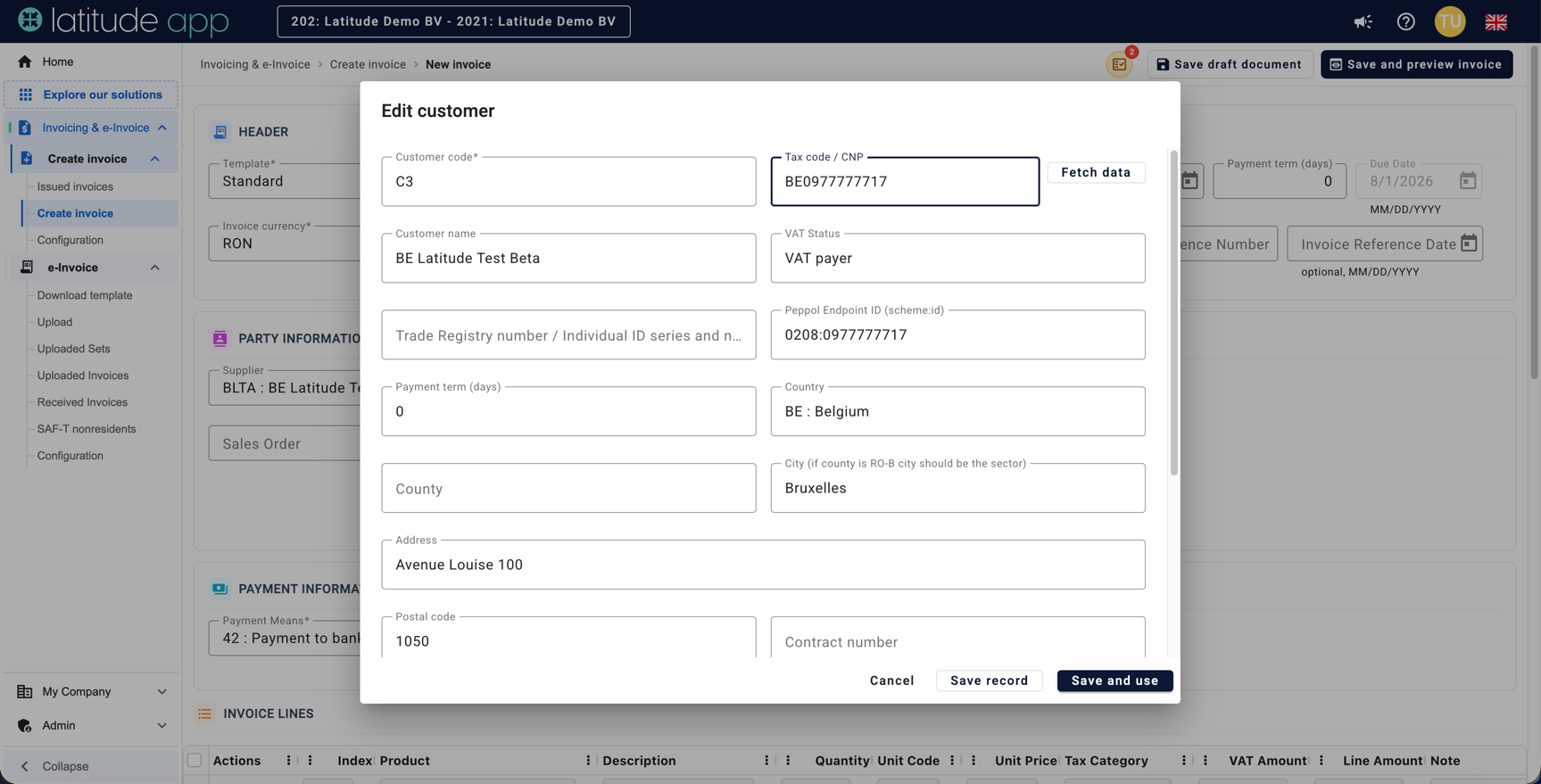
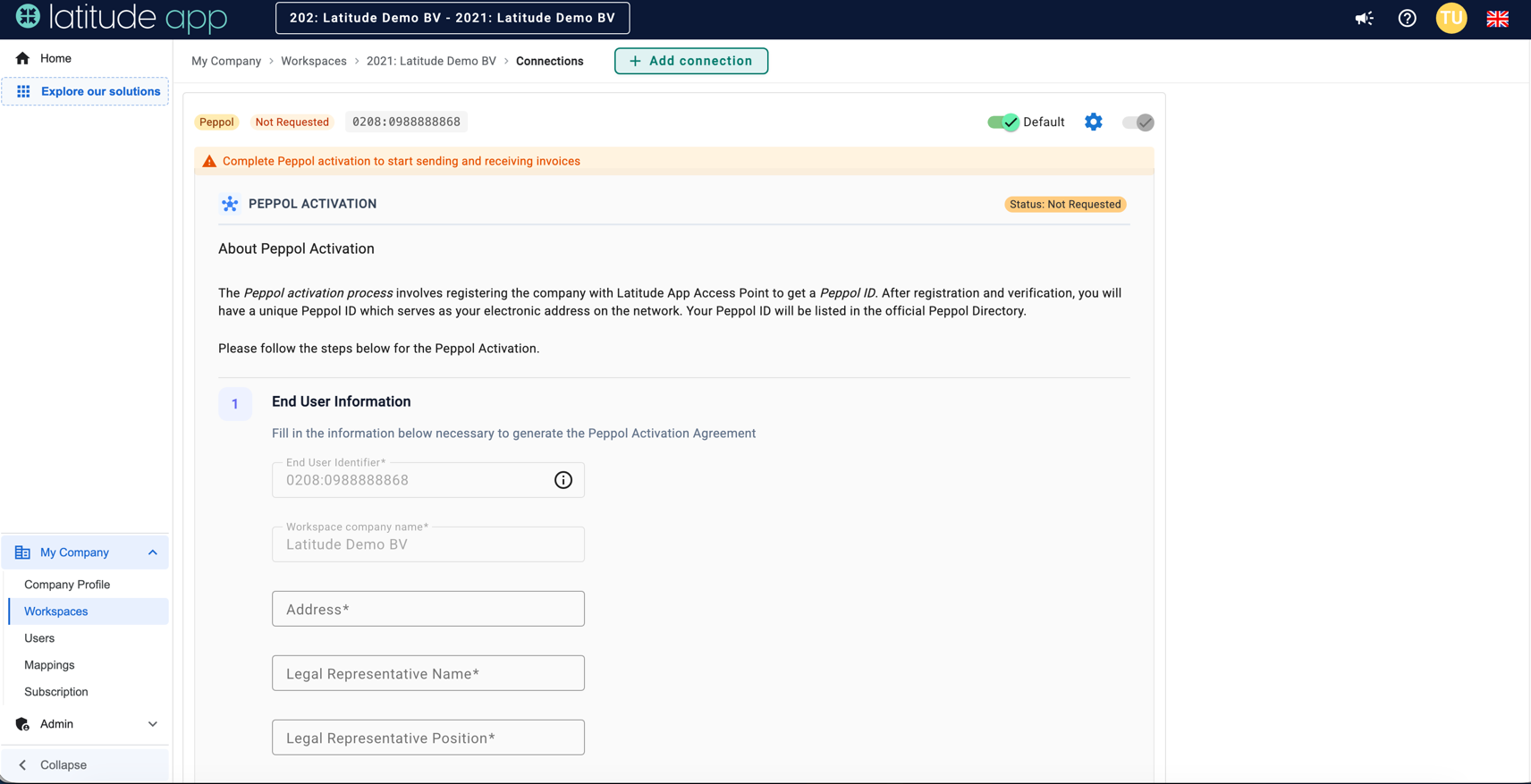
On the Peppol network your company is addressed by scheme 0208, the Belgian enterprise number, followed by your own company number, without the "BE" prefix. When you join Latitude App we register that ID at our Access Point; from that moment, every invoice sent to your number arrives in the platform automatically.
Your enterprise number is your VAT number without the BE prefix. Suppliers need no setup at all: the network finds you through the Peppol directory.
Issue structured e-invoices (Peppol BIS 3.0 / EN 16931) for domestic B2B, from 1 January 2026
Issue in the app, upload your UBL or use a custom integration, everything validated against Peppol BIS before anything leaves
Be able to receive structured e-invoices: a PDF by e-mail no longer counts
Your participant ID registered at our Access Point; invoices arrive automatically, with a readable rendering next to the XML
Exchange over the Peppol network, through an Access Point
Latitude App is a certified Access Point: one contract, everything included
Follow up on delivery and on your customers' responses
Delivery confirmations, validation results and accept or reject responses, as clear statuses on each invoice
Invoices to Belgian public bodies via Peppol (Mercurius)
The same channel and the same platform cover your public-sector customers
Keep a complete archive of invoices and delivery evidence
Every file, whether sent, received or a response, stored and downloadable at any time
Inside the app
What it looks like in Latitude App
Real screenshots from the platform, from issuing all the way to the final Peppol status.
We send PDF invoices by e-mail today. Can we keep doing that?
Between Belgian businesses, no: since 1 January 2026 the legally valid invoice for domestic B2B transactions is the structured one. The parties may agree on another EN 16931-compliant format instead of Peppol BIS, but both sides must still be capable of exchanging over Peppol, so in practice the network is the default. You can of course still attach a PDF for human eyes; Latitude App generates a readable rendering automatically.
What if our customer isn't reachable on Peppol?
Every in-scope Belgian business must be able to receive structured invoices since the same date, and the Hermes fallback service, which used to bridge to e-mail, retired at the end of 2025. If delivery fails, you see it immediately in Latitude App through the network's delivery status, and can chase the customer with facts. An administrative tolerance period applied in the first months of 2026, but readiness is now expected.
How do suppliers send invoices to us?
They address your participant ID: scheme 0208 plus your enterprise number (your VAT number without the BE prefix). We register that ID at our Access Point when you join; no action is needed from your suppliers, whose systems find you automatically through the Peppol directory. From that moment their invoices appear in Latitude App as they arrive.
Do we need to know UBL or Peppol BIS?
No. You issue invoices in the app or upload your XML, and the platform validates everything against Peppol BIS 3.0 / EN 16931 before it leaves. The Belgian specifics, such as participant schemes, VAT categories and response messages, are handled automatically.
Our software can only export invoices in its own format. What can we do?
Contact us and we set up a custom implementation project: we build an integration that takes the format your system exports and loads it into Latitude App automatically, where it is validated against Peppol BIS 3.0 and sent like any other invoice. We support custom development for exactly these cases, where the standard format isn't available.
We're an international group with a Belgian entity. Does this work for us?
Perfectly. The Belgian entity exchanges invoices over Peppol like any Belgian company, while the rest of the group runs its own countries in the same platform: Romania's ANAF e-Factura, Italy's SDI, Peppol in Germany and France, 24 European countries in total.
This article is for information purposes only and does not constitute tax or legal advice. Belgian e-invoicing rules may change; the information reflects the situation at the date of the last update.
Beyond Belgium
The same platform, across 24 European countries


Testimonials
What our clients say
Real feedback from companies across Romania and international clients using Latitude App for tax compliance.
Want a process this simple too?
Book a demo
Gabriel Băluță
Senior Accountant
Banking
Société Générale Global Solution Centre SA
Latitude App is very useful, reliable, and user-friendly. We integrated the app with our ERP for incoming and outgoing invoices and automated e-Invoice transfer with SPV, which helped us comply more easily with legal requirements and improve process efficiency.

BrandSafway Shared Services SRL
GL Team Leader
Support Services
Latitude App is incredibly user-friendly, intuitive, and customer-focused. Its intuitive interface helps us provide improved quality services, significantly reduces process times, and makes it an essential tool for our daily operations.
Alstom GCC Romania SRL
Chief Accountant
Shared Services
Latitude App is intuitive, fast, and reliable, handling invoices smoothly while ensuring compliance and saving valuable time through automation. The e-Invoicing app has had a highly positive impact on our organization by reducing manual effort, minimizing errors, accelerating financial workflows, and strengthening audit readiness.

Morar Elena-Mihaela
Construcții
Hunnebeck Romania SRL
Latitude App simplifies the invoicing process and makes day-to-day operations easier to manage. The application is intuitive, quick to learn, and provides exactly the functionality our team needs to efficiently manage electronic invoicing requirements.












Start exchanging Peppol invoices the easy way
Connect your company in a few steps and your first structured invoice can leave Latitude App today. No hand-crafted XML, no separate Access Point contract, no intermediaries.