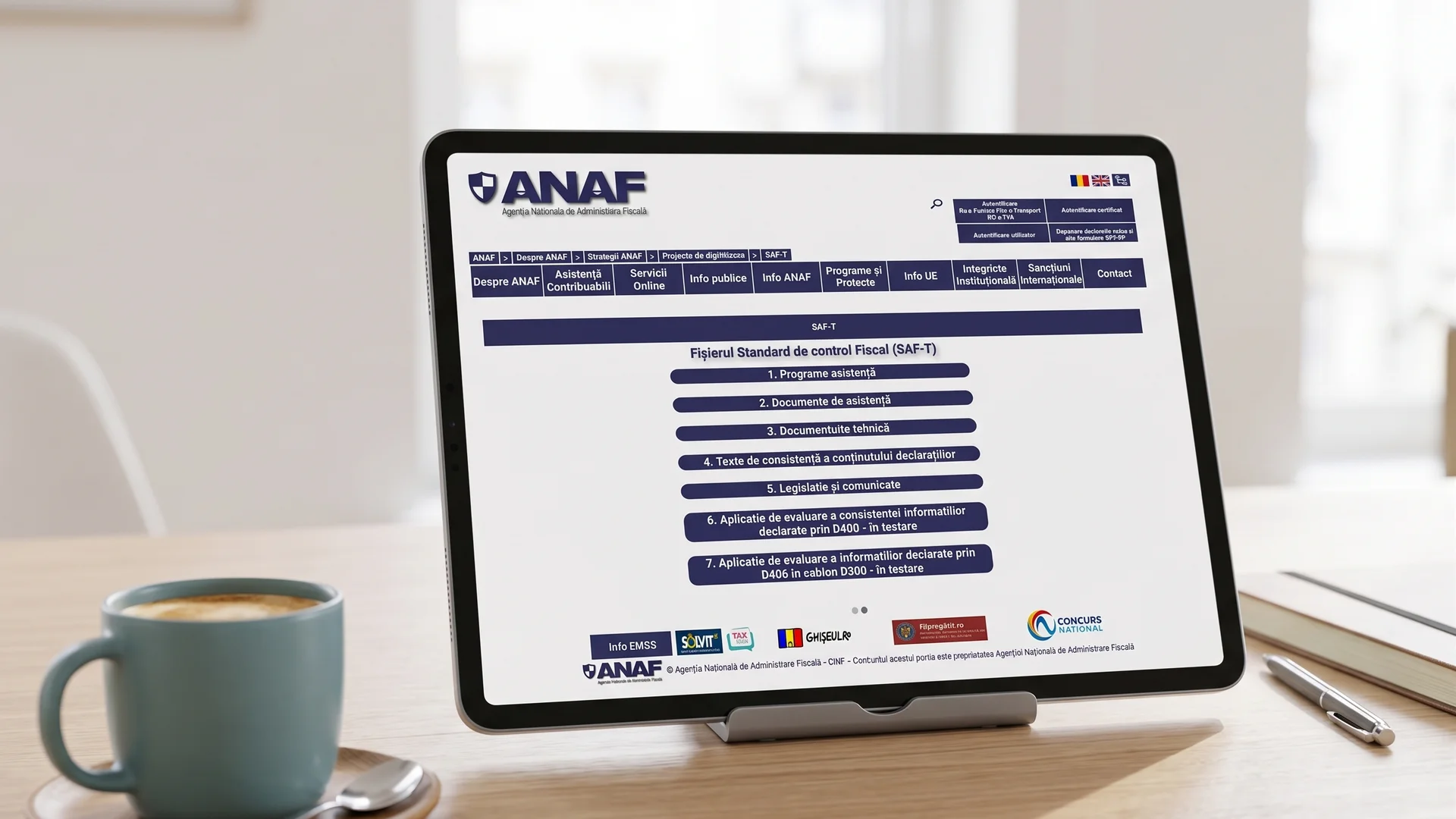
At the end of August 2026, ANAF, the Romanian tax authority, published two new verification applications for the SAF-T (D406) return: one that runs 11 consistency tests on the VAT information in the SAF-T file, and one that fills in the D300 VAT return template using the data declared in D406.
Both applications require a local Java installation, a manual run for every file and the interpretation of the resulting output files.
To simplify the verification of the SAF-T return, we have integrated all the ANAF tools into Latitude App, i.e. both the DUK Integrator and the two new applications: you upload the SAF-T declaration XML and the platform runs the official ANAF applications, returning the result right in the browser, identical to what you would get using the ANAF applications yourself.
What the two ANAF applications for D406 verification are
Two new sections appeared on the SAF-T page of the ANAF website, both marked as "in testing": the "Application for evaluating the consistency of the information declared through D406" and the "Application for evaluating the information declared through D406 in the D300 template".
1. The D406 consistency tests
The first application, published as the "Application for evaluating the consistency of the information declared through D406", runs 11 consistency tests on the VAT information in the accounting entries reported in the SAF-T return, in the "GeneralLedgerEntries" section (Rom. "Înregistrări Contabile – Registrul Jurnal").
The tests follow the correlations between the taxable base and the recorded tax: the tax codes used, the rates applied, the consistency between base and tax. The 11 consistency tests run by this application are the same ones behind the inconsistency notifications ANAF has been sending taxpayers in recent years.
Run locally, the application generates a series of CSV files: one with the identification data of the return and, when problems exist, one CSV file with the errors found for each of the 11 tests, listing the transactions that fail the tested conditions.
2. The D300 VAT return generated from D406 (D300_2026)
The second application, published as the "Application for evaluating the information declared through D406 in the D300 template", takes the VAT information from the same D406 file and automatically fills in the D300 VAT return template: taxable base and tax, row by row. The result can be exported as PDF, XML or JSON.
In practice, ANAF generates the D300 return using the data declared in SAF-T, and will be able to automatically identify any inconsistencies between the VAT return actually filed by taxpayers and the one derived from D406.
Why you should run these checks before filing the SAF-T return
The two applications are a welcome step towards transparency: ANAF publishes the very tools you can use to evaluate the consistency of your data yourself, before it reaches the authority's systems.
Running the consistency tests shows early what could later trigger an inconsistency notification, so the data can be corrected at the source, without the pressure of a response deadline.
Comparing the D300 return with the one derived from SAF-T, before filing the SAF-T return, reveals the types of operations that generate differences and that could draw the authorities' attention for further checks.
Both the consistency tests and the correlations between SAF-T and the VAT return are included in the SAF-T analysis in Latitude App: our platform automatically verifies the accuracy of the VAT information in the SAF-T return, covering the 11 consistency tests and the check against D300, as well as a series of additional tests developed together with accounting and tax specialists, including checking SAF-T against the D390, D394 and D100 returns.
On top of that, you can now also run the two applications published by ANAF in the same place, in Latitude App.
How to run the ANAF applications online, with nothing to install
Run locally, on your own computer, the two applications each require a Java version (Java 8 and Java 17 respectively), a separate run for each application and patience with the resulting CSV files. In the RO SAF-T Verification module of Latitude App the same result is obtained from the browser:
- You upload the D406 declaration XML to Latitude App.
- The platform runs the official ANAF applications and returns a result identical 1:1 to what you would get by running the applications on a local computer.
- You see the result directly in the platform, separately for the consistency tests and for the generated D300 return.
- You download the results: the consistency test results and the generated D300 return can be downloaded from Latitude App. In addition, for the consistency tests we also transpose the CSVs generated by the ANAF application into a consolidated Excel file, easier to read than the raw CSVs.
The ANAF applications, alongside the platform's other checks
The two ANAF tools complement the existing checks in Latitude App's RO SAF-T Verification module: validating the return with DUKIntegrator, ANAF's official validator, the correlations between D406 and the D300, D390 and D394 returns, the verification of customer and supplier data, and the Excel export of the return for analysis and audit. You run them all in one place, on the same SAF-T file.
Test it for free, with your own file
Anyone can try it: create a free account, upload your D406 file and see the official ANAF result within minutes, with the documents generated by the ANAF applications downloadable straight from the platform. No Java, no command line, no installs.
Frequently asked questions
What do the 11 ANAF consistency tests for D406 check?
The tests analyse the VAT information in the accounting entries reported in the SAF-T return: the VAT codes used, the rates applied and the correlation between the taxable base and the recorded tax. They are the same checks described in ANAF's communications about inconsistencies in SAF-T returns.
Do I need to install the ANAF applications or Java to use them?
No. In Latitude App everything runs online: you upload the D406 declaration XML in the browser and the platform runs the ANAF applications for you. You install nothing locally, neither Java nor the applications themselves.
Are the results in Latitude App identical to those of the ANAF applications?
Yes. The platform runs the very applications published by ANAF, not a reimplementation of them, so the generated documents are identical 1:1 to what you would get by running the applications on your own computer.
Can I download the documents generated by the ANAF applications?
Yes. The consistency test results and the D300 return generated from D406 can be downloaded directly from the platform. In addition, for the consistency tests we also transpose the CSVs generated by the ANAF application into a consolidated Excel file, easier to read than the raw CSVs.
Are these checks mandatory?
No. ANAF publishes both applications as tools "in testing", made available to taxpayers. They do show, however, exactly which correlations ANAF follows in the SAF-T data, so running them before filing is the simplest way to prevent later inconsistency notifications or additional checks from ANAF.
Simplify fiscal compliance with Latitude App
Invoicing, e-Invoice, e-Transport, SAF-T, e-VAT, VAT Statements, VAT Codes Check, Procure-to-Pay (P2P) and XML Reporting — all in one cloud platform. Test for free, no obligations.